English
 Italiano
 Français
 Español
 Deutsch





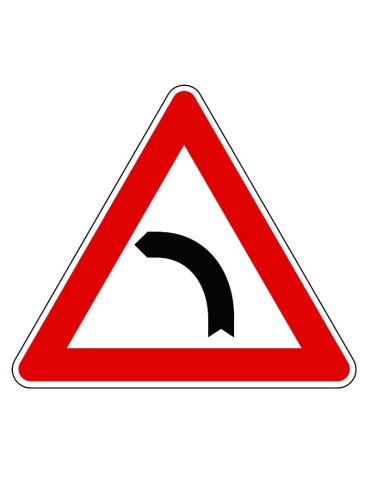
Warn of an asymmetrical bottleneck on the left with this 90 cm wide iron road sign. Essential for road and construction site safety.
L'ordine entro verrà spedito
The road sign "Asymmetrical Bottleneck on the Left", identified as Figure II.18 of the Highway Code, is a crucial element for the prevention of accidents. Designed to warn drivers of narrowing of the road on the left-hand side only, this sign allows them to adopt a cautious driving behaviour, especially in urban, secondary extra-urban or construction site areas.
This warning sign is made of boxed iron, with a thickness of 10/10 mm, ensuring robustness and high resistance to corrosion, essential for a long life even in adverse weather conditions. Its triangular shape with an upward-facing vertex and a side of 90 cm make it clearly visible and complies with standards for installation on secondary urban and suburban roads.
Class 1 (RA1) reflective film ensures adequate visibility in standard light situations and on illuminated roads, helping to keep drivers' attention high. The standard colours (white background, red border, black pictogram) and the clear graphic symbol (vertical right line and inclined left line) allow an immediate understanding of the message conveyed by the signal.
The signal warns of a potential hazard that can affect the driving path of vehicles, especially large ones. It is essential to warn of the presence of left-hand side obstacles, such as barriers, masonry or construction site delimitations, significantly reducing the risk of side collisions, especially in heavy traffic conditions or reduced visibility.
Installation is recommended at a regulatory distance from the narrowing point, based on the permissible speed on the road, and at a lower edge height above the ground of at least 2.20 meters. Mounting is suitable for 48 mm diameter galvanized poles or equivalent structures, ensuring stability and compliance with current regulations.
This sign fully complies with the Highway Code (Legislative Decree 285/1992, Art. 39) and its Implementing Regulation (Presidential Decree 495/1992, Figure II.18), as well as the UNI EN 12899-1 technical standards for permanent vertical signs.
The sign indicates a narrowing of the road that occurs exclusively on the left side of the road, warning drivers to pay attention and change the trajectory if necessary.
The sign has a triangular shape with a side of 90 cm, a standard size suitable for use on urban and secondary country roads.
The reflective film is Class 1 (RA1), approved to ensure standard visibility on illuminated roads or in urban contexts.
The sign is made of boxed iron with a thickness of 10/10 mm, a material known for its strength and corrosion resistance.
The recommended height of the lower edge of the signal from the ground is at least 2.20 meters, to ensure maximum visibility.
You might also like